
Better Analysis Part 3 - Holmesian Logic
Learning to think like the detective


This is part three of the Better Analysis series. See part one here on realism and part two here on diversity and red teaming.
Analysts should not only understand intelligence gathering and relevant subject areas, but they should also understand how they process information as analysts. One of the best teachers about processing information comes from British literature: Sherlock Holmes. There is a specific peculiarity in discussing Sir Arthur Conan Doyle’s Sherlock Holmes when it comes to intelligence analysis, but even as a literary detective, Holmes offers several significant lessons on how to think. Each of those lessons are directly applicable to the work intelligence analysts do.
When the reader is introduced to Holmes in A Study in Scarlett, Dr. John Watson gives a glimpse into the impressive way in which the detective deduces an important fact about him. When they meet, Holmes deduces that Watson had recently come from Afghanistan. In “A Scandal in Bohemia,” Holmes impresses Watson—as he so often does—that the doctor had gained seven pounds, recently walked in bad weather, and had a terrible maid. Holmes shows an extraordinary skill of perception and deduction from which analyst can learn. As Maria Konnikova put it, “In Arthur Conan Doyle’s own estimation, Sherlock Holmes was meant from the onset to be an embodiment of the scientific, an ideal that we could aspire to, if never emulate altogether” (Mastermind, p. 12).
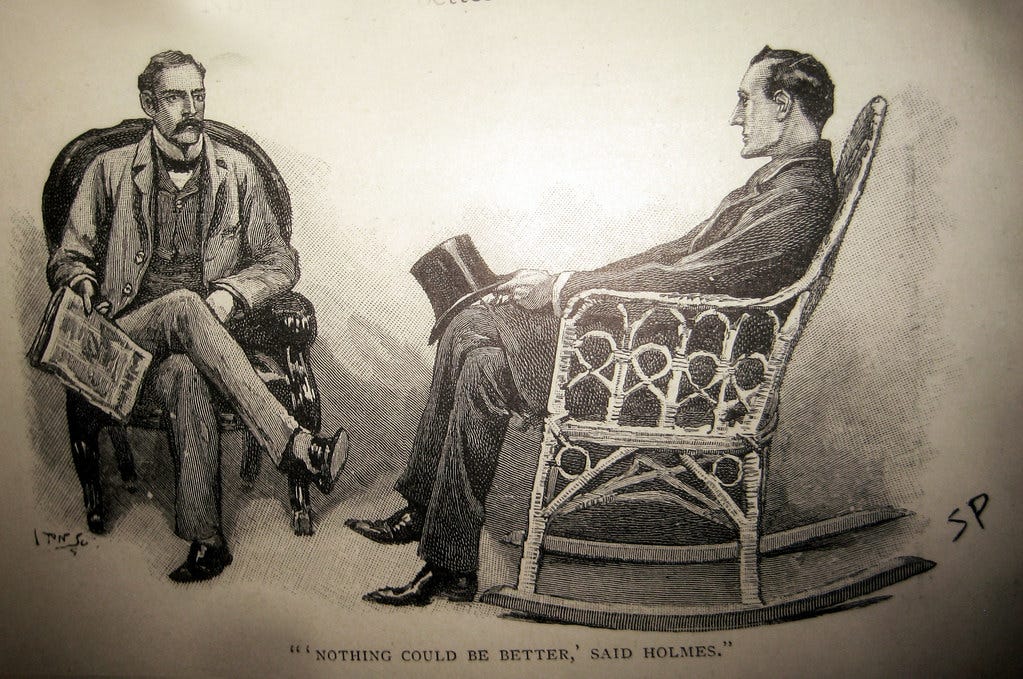
Abductive Reasoning
Part of this consideration is what is called abductive reasoning, which is essential for an intelligence analyst. The two primary means of formal reasoning are either deductive or inductive, and the former is considered the scientific approach while historians tend to use the latter. Deductive reasoning is where an individual will conduct an experiment or assess a particular case study in order to test a hypothesis, and then create a generalizable observation based on that experiment or case. For example, an international relations scholar might hypothesize that economic interdependence reduces the likelihood of violence, gather data to test the hypothesis, and then confirm or reject the hypothesis. Inductive reasoning is the opposite in which an individual will collect all the information possible, do a meta-history, or all the case studies on a single topic, and then craft a theory about a limited conclusion. For example, a diplomatic historian might look at the history of treaty making from the Peace of Westphalia to present and craft a theory about how treaties are crafted by nation-states.
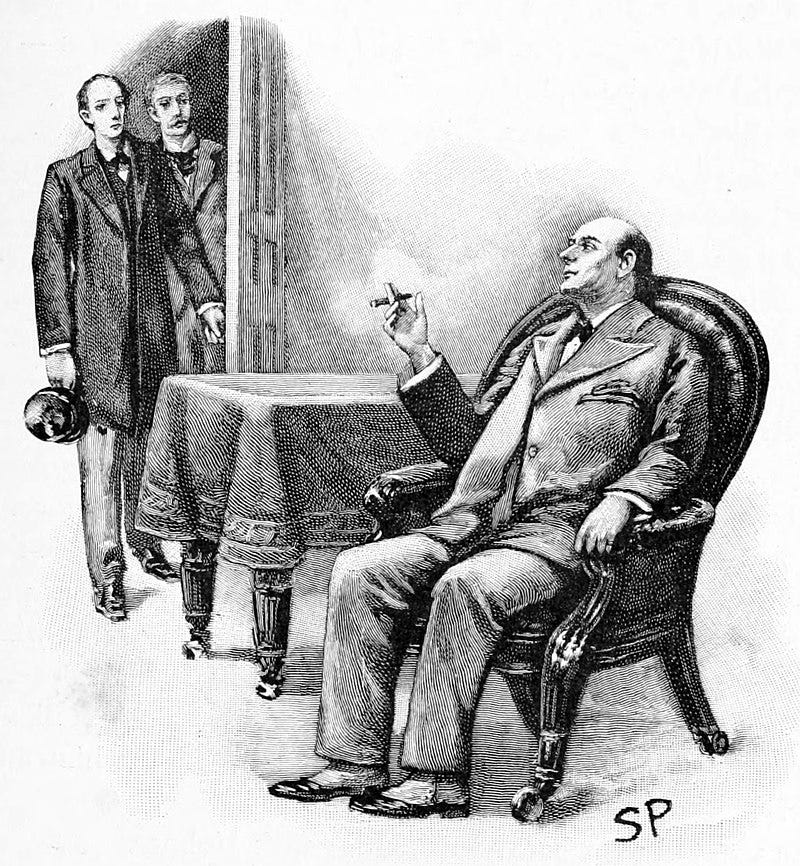
Abductive reasoning is different in that an individual will bring together an experiment, case study, observation, etc. and draw a limited conclusion. Sherlock and Mycroft Holmes attempting to outdo each other in “The Adventure of the Greek Interpreter” gives interesting examples of abductive reasoning. When Dr. Watson meets Mycroft, the detective and his brother sit at the window and observe the “billiard-marker and the other.” In succession, Sherlock and Mycroft conclude that the “other” was a soldier, recently discharged, had served in India, a non-commissioned officer in Royal Artillery, and a widower with children. They came to these conclusions based on his boots, manner of walking, tan line, mourning expression, and that he was purchasing toys. A small piece of evidence, for example the man wearing ammunition boots, led to a limited conclusion that he was a recently discharged soldier.
Abductive reasoning is fundamental to intelligence analysis because analysts are not creating generalizable theories about global politics. Rather, they are focusing on a limited number of data points to determine probabilistically how events will unfold over a given period of time. That is why abductive reasoning, truly understanding how to apply it, is so useful for analysis because at its core such reasoning is all about likelihood. Holmes does not know for certain that his conclusions are correct. He simply guesses the most likely causes of a particular piece of data. For example, say that a person has a Tennessee license plate. You could deduce with high certainty that the person currently or recently lived in Tennessee. Then you notice a University of Tennessee sticker on the vehicle as well. It is reasonable to assume based on available data that the majority of students at a state school are in-state students. Therefore, probabilistically you could deduce the person not only lives in Tennessee but was also born there. Now, what is important to remember with abductive reasoning (and probability) is that likelihoods are not absolute. An analyst is just trying to derive the most likely explanation. If something were to occur nine out of ten times, then over ten iterations it still would not occur once.
Organizing Information in Your Head
When Sherlock Holmes describes his approach to information, he states that he considers a person’s brain to be like an attic. As he says in A Study in Scarlet, “I consider that a man’s brain originally is like a little empty attic, and you have to stock it with such furniture as you choose.” A fool, according to Holmes, is one that takes in all the information and crowds out important details or jumbles it all together. However, the skillful workman is careful about what he puts into his brain and only has the tools necessary to do his work. This description comes from the humorous conversation about how Holmes purposefully forgets that the sun revolves around the sun so as not to crowd out important information. Whether Holmes is right that taking in too much information crowds out or jumbles important details is inconsequential to the most important lesson from his technique. The relevant lesson is that analysts need to be aware of and solidify in their minds the fundamental skills and necessary base knowledge to successfully observe, deduce, and forecast.
Analysts need to understand the structure of their brain attic and “its habitual modes of thought and operation, the way in which we’ve learned, over time, to look at and evaluate the world, the biases and heuristics that shape our intuitive, immediate perception of reality” (Mastermind, p. 36). For geopolitical risk intelligence, this includes a myriad of subjects, but also the general socio-political, economic, and policy processes that relate to each of the subjects. If an analyst has these skills and understands them, then it does not matter what events unfold that could impact one’s client. Say the analyst is an expert in American politics but suddenly has to analyze an election in Colombia. Because the skillset already exists for understanding electoral processes, those skills become transferable to the new political event. This is why analysts must be cognizant of their brain attics and skills/information need to do their jobs.
Application
The most significant skill that Holmes has is the ability to put together data points, link each one together, draw a conclusion, and then walk another person through the process. Dr. Joseph Bell, the real-life physician on which Doyle based Holmes, wrote about the character, describing Holmes’s ability to bring together the “trivial, or apparently trivial, links in his chain of evidence. These are at once so obvious, when explained, so easy, once you know them, that the ingenuous reader at once feels, and says to himself, I also could do this.” An analyst needs to emulate this way of thinking, writing, and explaining data and the appropriate interpretation. The brain attic gives one the skills/information to do this, and abductive reasoning brings the links together. For multiple cases Holmes will collect the information and observations and then walk the police and Dr. Watson through the process and how he came to his conclusion.
In “The Adventure of Silver Blaze,” Holmes and Dr. Watson have to deal with a missing horse (Silver Blaze) and dead trainer (John Straker). Holmes deduces that the trainer was the one who took the horse to injure it in order to win money on a bet. When explaining the evidence to the horse’s owner, he lays out the information to link each of his conclusions. Because the stable boy was poisoned by powdered opium, Holmes realized that the curry served to cover the taste precluded a stranger (in the case the suspect is Fitzroy Simpson) from doing it, meaning it had to be one of the two people who served the stable boy his food. In addition, the guard dog did not bark, meaning a stranger could not have come into the stables. Holmes came to the conclusion that the trainer had to be up to nefarious purposes based on the type of knife found in his hand after died, a knife for surgery rather than self-defense. Straker’s motive became clear because of the bill found in his pocket, indicating he had a mistress with expensive tastes. Importantly, Holmes could link each conclusion with the evidence and bring the links together to completely explain Straker’s motives and death. Analysts must also be able to do this process. They cannot simply state conclusions without establishing the complete process of analysis (even if they only give the process when specifically asked). See the video below for a dramatic version of this from the BBC show Sherlock.
The important lessons from Sherlock Holmes are that an analyst should know how they observe (gather information and intelligence), how to organize information in their minds, how they come to conclusions, and successfully explain each of the links in their observation to conclusion. These lessons apply to any kind of analysis, and they are helpful to remember when working through a problem.